
 Subscribe
| A data dictionary (also called a codebook) is one of the most important pieces of documentation you will ever create for your research dataset. It is essentially the “user manual” for your data — without it, even the cleanest spreadsheet or database becomes difficult, if not impossible, for others (and often your future self) to understand and reuse. In this blog post, we'll explain what a data dictionary, or codebook, is and why it's so important in research data management. We then explore the essential steps and best practices for creating a robust data dictionary or codebook and provide a practical guide for researchers. 15 Apr 2026 [3 min read] |

Read More
What is a Data Dictionary or Codebook?
A data dictionary, also known as a codebook, is a detailed description of the data in a dataset. It includes information about each variable, such as its name, type, format, possible values, and meaning. Essentially, it acts as a "user manual" or roadmap for anyone who needs to understand, work with, or reuse the data.
What is the difference between a Data Dictionary and a Codebook?
- Data Dictionary: Focuses on variables — what each column means, its type, units, valid values, missing-value codes, etc. Most common for tabular/quantitative data.
- Codebook: Broader term that also includes study-level information (questionnaire text, survey flow, sampling method, data collection process). Very common in social sciences and survey research.
In practice, most researchers use the two terms interchangeably.
Why does a high-quality Data Dictionary matter?
- Many funders and journals require submission of Data Management Plans. A high-quality data dictionary will definitely expedite approval processes.
- It provides clarity on what each variable represents, making it easier for users to interpret the data correctly. As a result, the citation rate of your dataset will be increased.
- By documenting the data structure and constraints, it helps maintain data integrity and consistency. Hence, errors can be reduced when others (or you) work with the data.
- Analysts can effectively identify variables and understand their context, which enables secondary analysis and meta-analysis.
- Makes your data FAIR (Findable, Accessible, Interoperable, Reusable) compliant.
Step-by-Step: How to create a high-quality Data Dictionary
- Decide the Scope and Format
- Use a simple spreadsheet-style dictionary for Tabular data such as Excel, CSV, SPSS, Stata, R, etc.
- Use a full codebook with question text for Survey / Questionnaire data
- Combine both for Mixed or Complex data
- Recommended formats:
- Excel / Google Sheets (most accessible)
- Markdown table (easy to put in README files)
- PDF (the final archival version)
- JSON / XML (machine-readable, advanced)
- Include all essential fields
Column / Section What to put here Example Variable name Exact column name in the dataset income_2023Variable label Human-readable description (1–2 sentences) Annual household income in HKD (2023) Question text (if survey) Full wording of the survey question “What was your total household income last year?” Data type Numeric, String/Text, Date, Categorical, Boolean, etc. Numeric Units e.g., HKD, kg, %, years, etc. HKD Value range / Valid values Minimum, maximum, or list of allowed values 0 – 9999999 Value labels For categorical variables: code → meaning 1 = Full-time employed, 2 = Part-time, 3 = Unemployed Missing value codes How missing data is coded -99 = Refused, -88 = Don’t know Measurement level Nominal, Ordinal, Interval, Ratio, Binary Ratio Derivation / Calculation If the variable was calculated from others = income_monthly * 12 Source / Instrument Which questionnaire, sensor, or database it came from Wave 3 Household Survey Notes / Caveats Any special instructions or known issues Some respondents refused to answer - Build it systematically
- Start early - Begin drafting while you are still collecting or cleaning data.
- Use a template (refer to Step #4)
- One row per variable — never combine multiple variables in one row
- Be consistent — Use the same style and level of detail for every variable.
- Include a cover sheet with:
- Dataset title
- Version number and date
- Number of variables and observations
- Principal Investigator / Contact person
- License
- Citation recommendation
- Utilize tools and templates
Recommended free templates:
- R package: codebook or dataMaid
- Python: ydata-profiling or sweetviz (auto-generates basic dictionaries)
- Survey-specific: Qualtrics / REDCap export (convert to codebook)
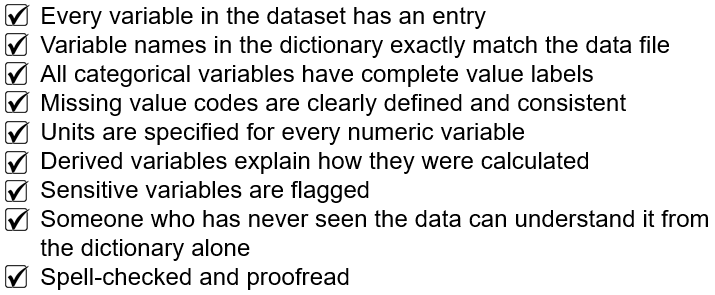
- Final review with a quality checklist
An example: Small excerpt from a real data dictionary
| Variable | Label | Type | Values | Missing codes |
|---|---|---|---|---|
age |
Respondent age in years | Numeric | 18–99 | -99 |
gender |
Gender | Categorical | 1 = Male, 2 = Female, 3 = Non-binary, 4 = Prefer not to say | -88 |
income_monthly |
Monthly household income (HKD) | Numeric | 0–999999 | -99 |
education_level |
Highest education level completed | Ordinal | 1 = Primary, 2 = Secondary, 3 = Bachelor, 4 = Postgraduate | -99 |
Conclusion
Creating a high-quality data dictionary or codebook is a crucial step in effective Research Data Management. By providing a clear and comprehensive guide to your dataset, you enhance data understanding, quality, and collaboration. Follow the steps and best practices outlined in this blog to develop a data dictionary that serves as a valuable resource for all data users. Remember, a well-crafted data dictionary is not just a document—it's a key to unlocking your data's full potential. A good data dictionary takes time (usually 1–3 days for a medium-sized project), but it is one of the highest-ROI activities in RDM. It turns a “data file” into a reusable scientific asset.